
About Us
Our Story
Welcome! We specialize in producing quality certified organic garlic seed and culinary garlic, as well as delicious 100% grassfed lamb.
Our patchwork of rolling prairie, woods, and wetlands is located on the Coteau des Prairies, a long, high ridge in northeastern South Dakota. We began Prairie Coteau as a Community Supported Agriculture (CSA) and market farm, but after several years of harvesting beautiful garlic for our CSA shares, we decided to focus our efforts there.
Since 2004, we’ve tested over twenty varieties and continue to try different cultivars to provide our customers with great flavor and quality. We currently offer seven varieties of garlic and select our own seed from among our stock each year to ensure we offer you the best. Seed companies, market farmers, home gardeners, restaurants, food co-ops and grocery stores comprise our diverse customer base.
In 2016 we added a flock of Clun Forest cross sheep to provide on-farm fertility and the ability to offer grassfed meat and fiber products. We are thrilled with the added challenge and enjoyment of raising these delightful animals.
As a certified organic farm, we utilize practices such as crop rotation, cover cropping, mulching and rotational grazing to produce a healthy crop without synthetic herbicides, pesticides or fertilizers. We apply composted manure from our sheep and horses and naturally-sourced minerals and amendments to encourage a well-balanced, biologically active soil.
Our garlic spends the winter tucked away under a thick mulch of native prairie grasses grown on our farm. Years ago we established several acres of perennial natives such as Big Bluestem, Indian grass and Switch grass for this purpose as well as to provide wildlife habitat and continuous soil cover. Our goal is to use natural systems to our advantage in a holistic approach to stewarding our land.

Meet the Farmers
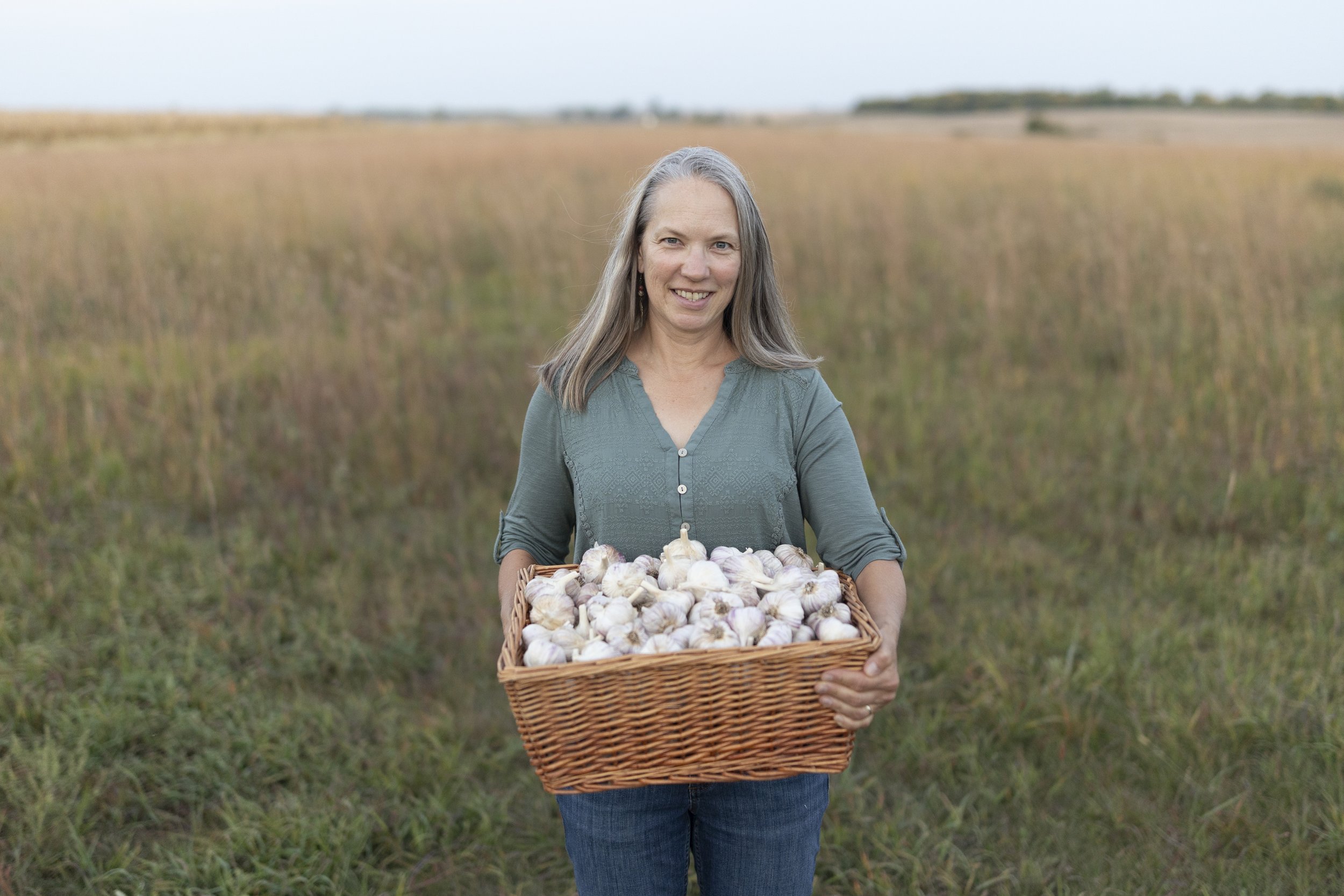
Kristianna Gehant Siddens
Head Grower, Shepherd, Quality Control Inspector

Nick Siddens
Engineer, Equipment Manager, Problem-Solver-in-Chief

Luna
Chicken Wrangler, Horse Whisperer, Forest Fairy

Georgia
Negotiator, Dancer, Friend-of-Lambs
Garlic Growing Basics
PLANTING:
Garlic does well in a variety of soils, but is especially suited to loose, rich soils high in organic matter. Be sure location has adequate drainage and water will not stand in heavy rains. Ideally, location should be somewhat protected from winter winds. Soil should be well fertilized with compost, manure or other organic amendments, such as fish meal. (A soil test is always useful to determine what's needed for your specific site.)
In the north, planting time is late September to early November, depending on location, and later the farther south you go. The ideal planting window for the Dakotas and Minnesota is roughly mid-October, but we’ve had success planting as late as early November.
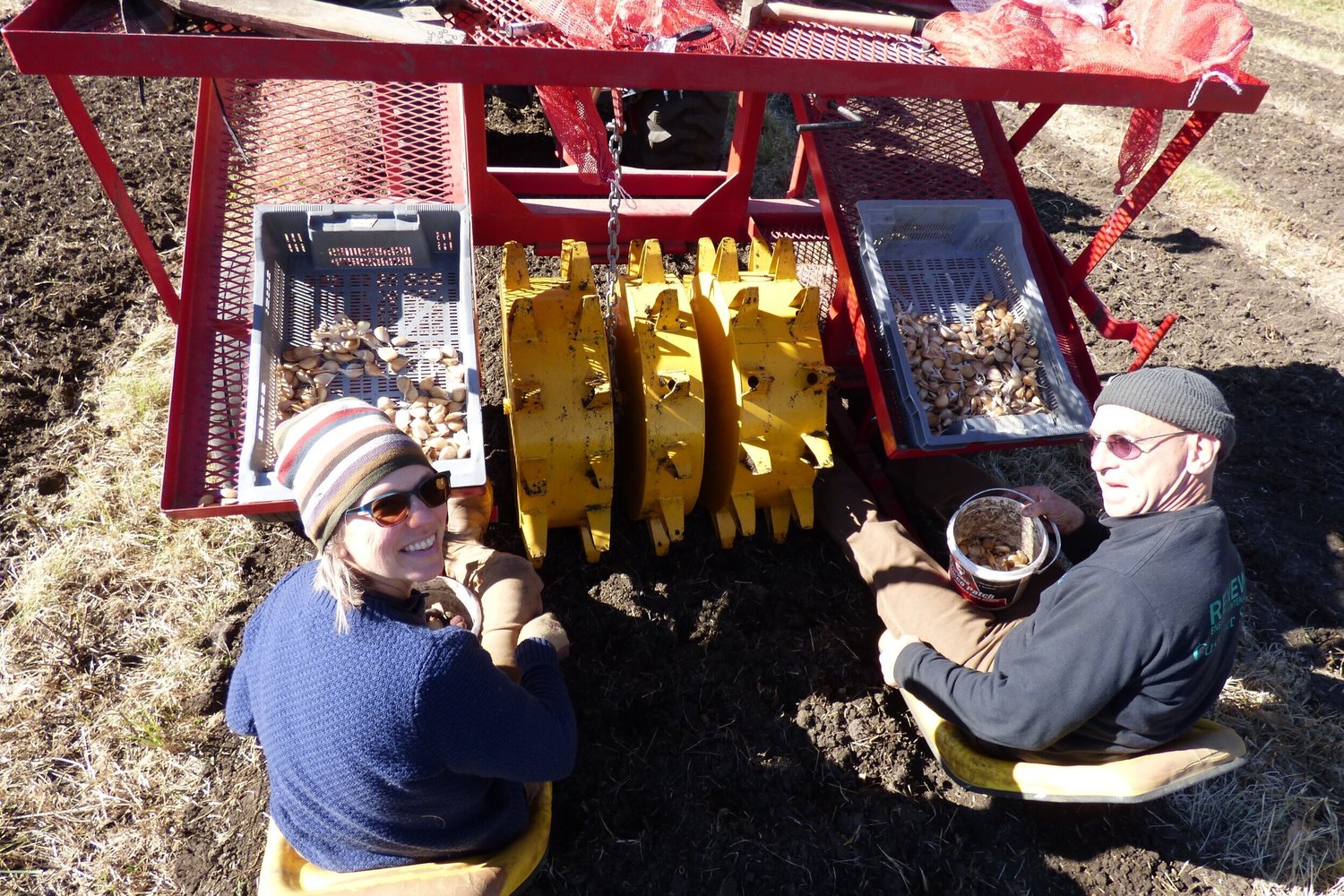
Separate the cloves. To guard against disease, mold and pests, soak the cloves in isopropyl alcohol for 5-10 minutes before planting. Either let them dry completely, or plant immediately. Plant them individually with the root plate down and the pointy end up about three inches deep and 6 to 8 inches apart. Rows should be 6 to 12 inches apart.
Mulch with 6 inches of loose material such as hay or straw. Avoid material which could form a heavy mat and prevent emergence of garlic in the spring. Mulching protects the cloves from heaving out of the soil during freeze-thaw cycles, prevents winter-kill from cold temperatures and provides some weed suppression and moisture retention in the spring. Mulch should not be removed in spring unless there is serious concern of rot due to extreme wetness. Our garlic has shown hardiness in a wide variety of conditions.
CARE:
One inch of water a week during the spring until two weeks before harvest is ideal; mulch will help retain soil moisture, but water requirements will depend on soil type. Again, our hardy varieties should withstand some water stress.
Foliar feeding or side-dressing with additional fertility (such as liquid fish and/or kelp) in the early spring can give garlic a boost, but only in the first couple of months after emergence. After that, additional nitrogen can inhibit bulb development.
Keep garlic weed-free. This means weeding early and often as weeds quickly reduce yield.
For hardneck varieties, harvest the scape (flower stalk) 7-14 days after it appears. It can be snapped off by hand where it grows out of the plant. If removed early when tender, it can be ground into pesto, sautéed or cooked like asparagus, or eaten in salads or casseroles. Removing the scape will increase bulb size. Softneck varieties do not have a scape.
HARVEST:
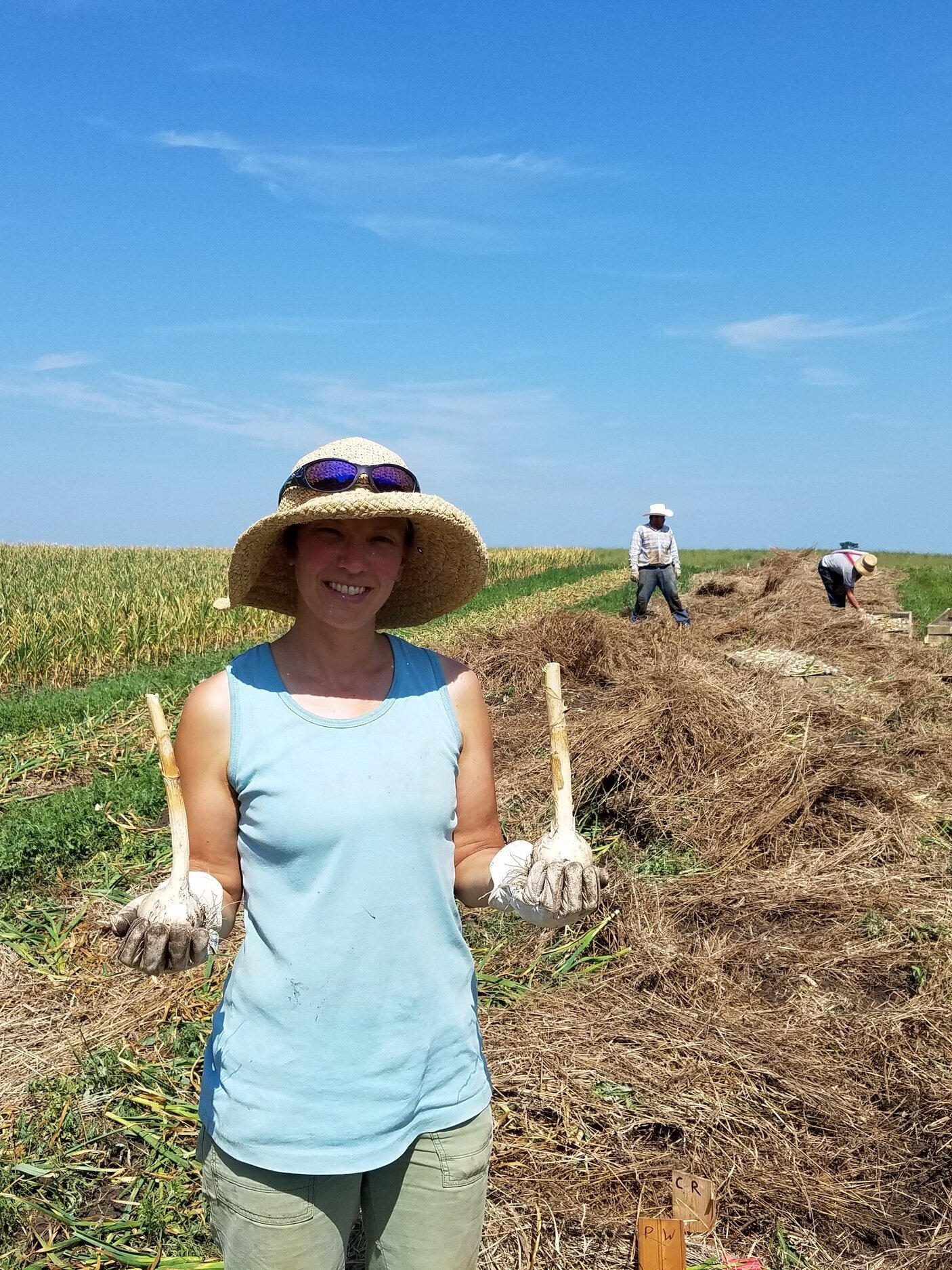
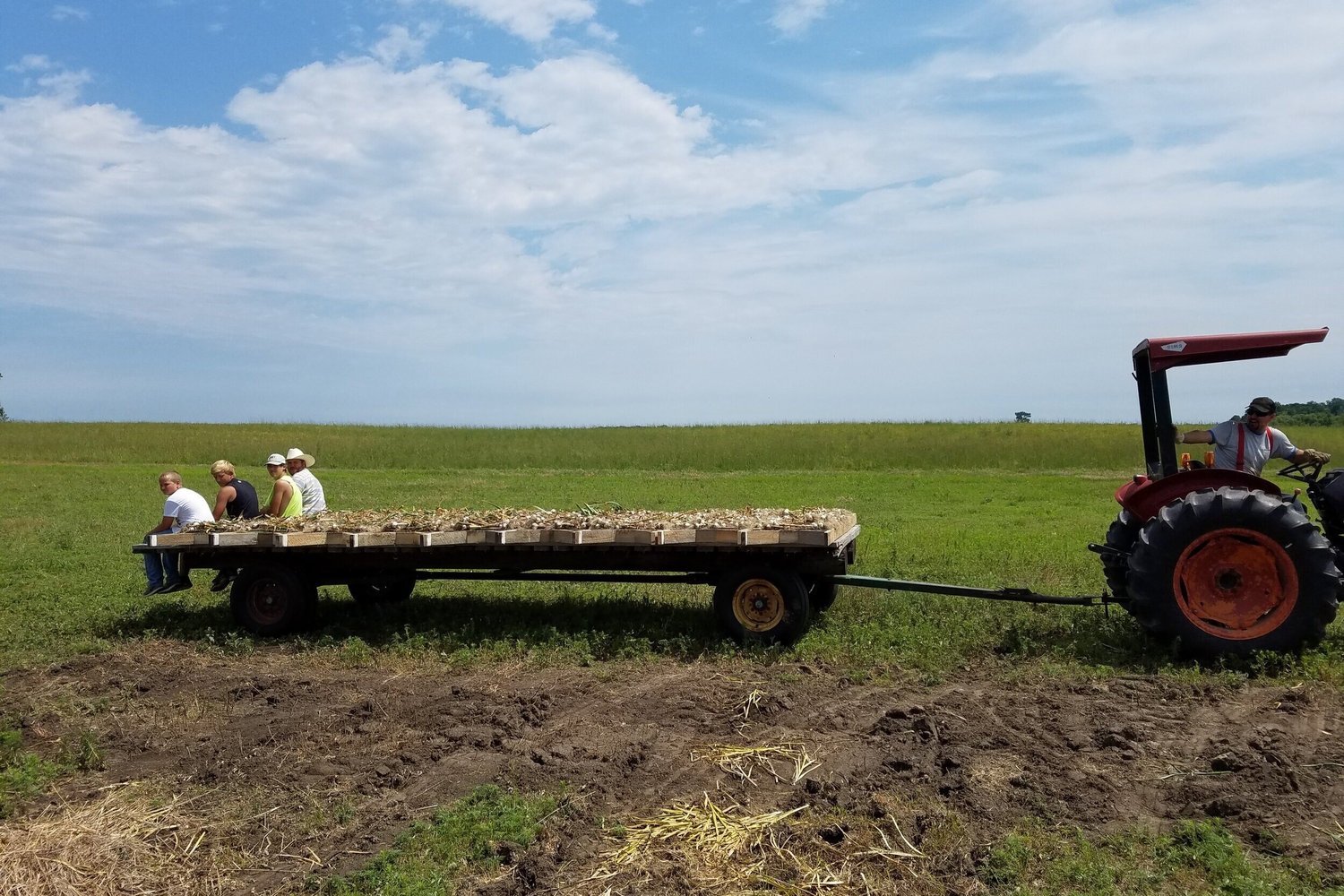
Different varieties of garlic will vary in length of time to maturity. In northeast South Dakota, harvest begins about the middle of July. Garlic should be dug (using a potato fork is easiest) on a dry day when about half the leaves have died back. Softneck varieties will be ready first. Avoid watering starting about two weeks before harvest. Leaving garlic in the ground too long will result in the bulb opening up, loss of wrapper skins and shortening of storage life.
Bunch garlic in groups of 10 or so and hang to cure out of the sun in a dry, well-ventilated place. Bulbs can be trimmed and used after 3-4 weeks of curing.
STORAGE:
Store garlic in a cool, well-ventilated place above 50 degrees F with some humidity. Keep bulbs whole. Most varieties of garlic should store into early spring. Garlic braided or with the stalk left on stores longer.
Enjoy!!
***Always handle garlic with care! It bruises easily like an apple and damage can invite disease and mold.