
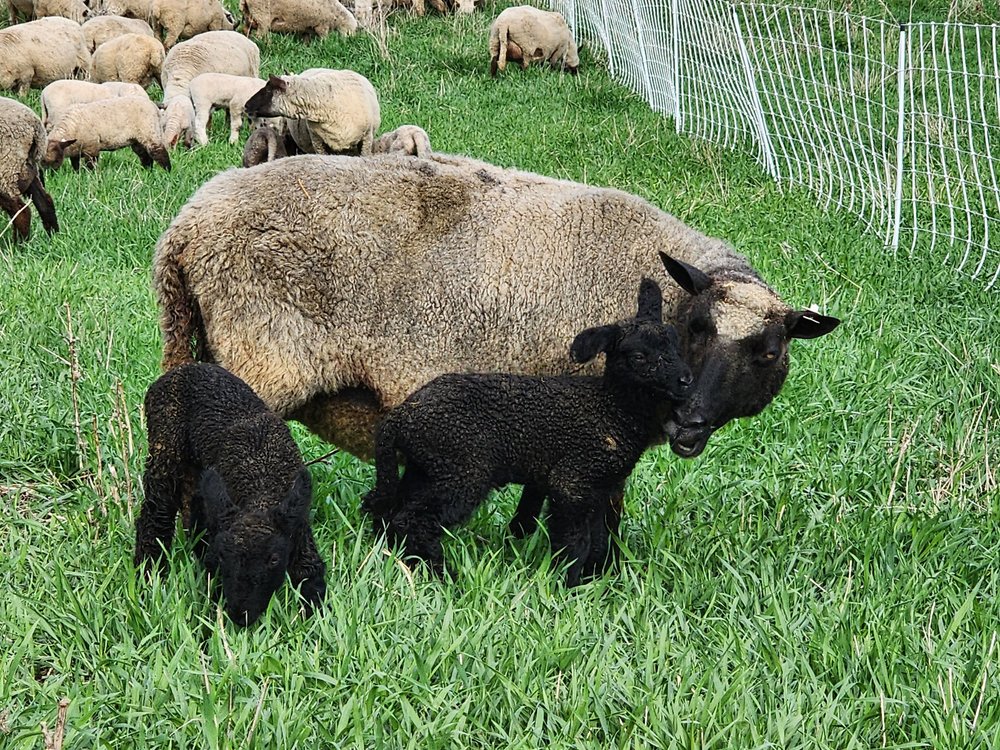
Cappella with her twin lambs a couple of days after birth.
Around 10 pm, as I walked down the porch steps and across the yard to check the barn after the rain, I heard the spring peepers louder than ever. They seemed exuberant in celebrating the swelling of their watery hideaways. The air was humid and the breeze carried that wonderful smell of wet tree bark and soil, a perfect spring evening.
The sheep were talkative and milling about in the barnyard, eager for me to get the pitchfork and scrape down more hay in their feeders. I walked into the barn and gazed around with my headlamp. I caught sight of a big ewe with a brand new lamb by her side. Yay! I felt the familiar little heart-thrill of joy. Seeing new lambs never gets old; after eight years of raising sheep, it’s still a delight every time!
As I got closer, I saw a second lamb splayed out in the straw with her tongue hanging out. I rushed over, this time my throat clenched in fear. Then, a wave of relief at seeing her little chest rise and fall. I rubbed her down with my hands. She responded by shaking her head and trying to sit up. I noticed her head was quite swollen, her eyelids puffy and red: signs of a difficult birth.
I stepped back to observe. Mama ewe was attentively licking the lamb, but panting and obviously exhausted. Should I do something more, or let them be?
In previous lambing seasons, I would take newborn lambs and let the mother follow me with them into a maternity pen (called a jug) to stay for a day or two where I could watch them. But the last couple of years, I’ve found it’s more efficient for me and less disturbing for the new family to leave them alone. I check on them often and only jug them if the other lambs or ewes are a bother, the lamb has trouble nursing, or the new lambs are wanderers. (If I expand the flock much, I will likely return to the jug method.)
I forked down hay for the rest of the ewes and older lambs, which meant they all charged outside, giving the new mama some quiet space with her babies. After a long time watching this new lamb, and occasionally rubbing her down, I saw she was able to hold up her head for longer stretches and attempting to stand. She had a fairly weak sucking reflex, but I figured she needed rest and time to recover. I left the ewe to her lambs and went to bed hoping for the best.
Early this morning, between thunderstorms, I crossed the yard to the barn in soft light, listening to the sounds of the wind and twittering birds. The possible scenes flashed through my mind, from the worst: a dead lamb, to the best: a lively lamb up and nursing.
In the dim light of the barn as I walked among the sheep, I saw the mama ewe with just one little black lamb by her side. Then I spotted the other near the door. The swelling of her head was much reduced, and she was walking and bleating. Oh joy! I nudged her toward her mama who nosed her and made guttural sounds prompting the lamb to nuzzle up and search for the teat. When her little tail wiggled like a flag, I knew she was getting milk.
The other lambs romped and played around her. I scraped down the hay for the ewes outside, making sure to keep a quiet space at the feeder for the new mom. Soon, she brought her lambs over, and they stood by her side while she ate.
My daughter came out to see the new lambs, and together we gushed over their cute, black wooliness. I watched the pink sunrise through slanting stripes of rain in the distance and listened to the sounds of sheep chewing and lambs bah-ing for their mamas. When the water tanks were full and the other chores done, I smiled as I walked back to the house in the humid breeze. A perfect spring morning.
0 Comments